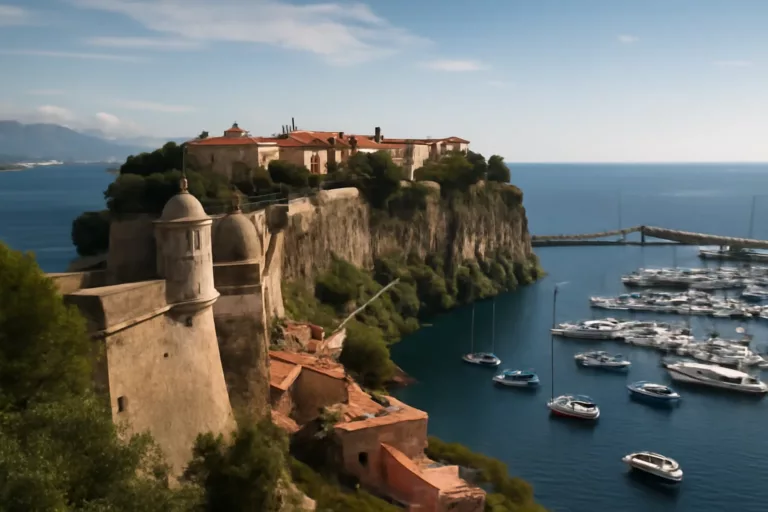
The origins of Monaco stretch far beyond the arrival of the Grimaldi family in the late thirteenth century. Long before coats of arms and casinos, this narrow strip of coast was a coveted harbour, a sacred headland and a fortified outpost that watched over a busy Mediterranean corridor.
By tracing seven milestones, you can see how geography, myth and strategy slowly turned a rocky promontory into a place worth fighting for. Following the origins of Monaco also reveals how each era layered new meanings onto the same headland, from a simple landmark to a powerful stronghold.
1. A rocky landmark in the prehistoric Mediterranean
Millennia before written records, the future Rock of Monaco dominated a coastline dotted with caves and small beaches. Nearby sites, such as the caves of the Riviera, show that prehistoric communities moved along this shore following game, fresh water and seasonal plants. Even at this early stage, the physical setting was already shaping the origins of Monaco as a place noticed and reused across generations.
For seafarers hugging the coast in small boats, the cliff that would become the Rock was an obvious marker. It rose sharply from the sea, signalling a change in the shoreline and hinting at shelter just beyond its base. Even without walls or quays, the natural landscape was already influencing human routes and laying down the first, faint lines in the story of the origins of Monaco.
2. The natural harbour becomes a safe haven
As coastal navigation improved, the small inlet at the foot of the Rock offered something rare on this steep shore: a relatively protected anchorage. Ships could wait out bad weather, repair damage or trade with people on land. This practical advantage would prove central in the long-term origins of Monaco as a recognised maritime stop.
In an era when storms, pirates and reefs could destroy a voyage, a safe harbour was a powerful asset. Captains learned to recognise the profile of the headland and the curve of the bay. Over time, the harbour became part of an informal network of stopovers that stitched together the western Mediterranean and quietly reinforced the maritime origins of Monaco.
3. Greek sailors and the first written references
The first clear written clues to the origins of Monaco come from the world of ancient Greece. From the sixth century BCE, Greek mariners sailed along this coast, trading metals, wine and ceramics. They left behind pottery fragments and, more importantly, names that fix the site on the mental maps of the ancient world.
Ancient authors mention a place called Monoikos, linked to the hero Heracles (Hercules). The name probably referred to both the harbour and the headland. It suggests that by this time the spot was well enough known to appear in sailing directions and stories told in distant ports, anchoring the literary and mythological layer in the origins of Monaco.
4. A sacred headland: the cult of Heracles Monoikos
One of the most revealing milestones in the origins of Monaco is the transformation of the site into a sacred headland. Greek tradition associated Monoikos with Heracles, worshipped here as a solitary, independent god. This religious layer added prestige to the harbour and drew travellers seeking protection.
For sailors, a sanctuary meant more than piety. It meant a recognised landmark, a place where vows could be made before a risky crossing and thanks could be offered after surviving a storm.
- Offerings and small altars reinforced the site’s reputation.
- Stories about Heracles’ strength underlined the headland’s protective image.
- Rituals helped create a shared identity among passing crews.
Religion, geography and navigation became tightly intertwined, giving the origins of Monaco a spiritual as well as strategic dimension that would echo in later centuries.
5. Roman engineers reshape the harbour
When Rome extended its influence along the Ligurian coast, the harbour and the Rock gained a new role in imperial logistics. Roman administrators valued reliable anchorages, and Monoecus fitted naturally into their coastal system, further formalising the origins of Monaco as a working port.
Archaeological traces and ancient texts point to modest but meaningful improvements:
| Feature | Probable Roman impact |
|---|---|
| Quays and moorings | Better berths for merchant and military ships |
| Storage areas | Spaces for goods in transit along the coast |
| Road links | Connections to inland routes and neighbouring settlements |
Under Rome, the harbour became more than a refuge. It was a small but useful cog in a vast trade and communications network that linked Spain, Gaul, Italy and beyond. The origins of Monaco thus expanded from local landmark to recognised point in an imperial system.
6. The Rock as a strategic lookout
While the harbour served commerce, the Rock itself offered something equally valuable: a commanding view. From its summit, observers could scan the sea lanes and the coastal road, spotting sails or columns of dust long before they arrived. Security joined trade and religion as a defining strand in the origins of Monaco.
This vantage point mattered whenever security was fragile. In late antiquity and the early Middle Ages, when central control weakened and coastal raids increased, a high lookout could mean the difference between surprise and preparation.
Simple defences, watch posts and signal fires likely appeared on the summit or its slopes, turning the natural cliff into an early warning system for the communities below and deepening the military aspect of the origins of Monaco.
7. From fortified outpost to pre-Grimaldi stronghold
By the time the Middle Ages unfolded, the overlapping roles of harbour, sanctuary and lookout had already defined the character of the site. Local powers and regional lords understood the advantages of controlling both the anchorage and the Rock.
Fortifications gradually thickened: walls encircled the summit, gates controlled access and buildings clustered in the most defensible spaces. Even before the Grimaldis arrived, the promontory functioned as a compact stronghold that could monitor movement along sea and land routes.
This is the final milestone in the early story. When the Grimaldi family entered the scene, they did not create a strategic position from nothing. They inherited centuries of accumulated value embedded in stone, myth and memory, all rooted in the long, complex origins of Monaco.
What these milestones reveal about Monaco’s early identity
Taken together, these seven stages show that the origins of Monaco are rooted in three enduring forces: geography, belief and security. A natural harbour drew ships; a sacred headland attracted stories and rituals; a watchful Rock offered protection.
Understanding this layered past makes it easier to see why such a small territory could later support a principality. The foundations were already there: a recognised name on ancient sea routes, a habit of watching the horizon and a tradition of adapting the Rock to new political realities. When you look at the modern principality through the lens of the origins of Monaco, the continuity between ancient harbour, medieval stronghold and contemporary state becomes much clearer.
Frequently asked questions
Was Monaco inhabited before the Grimaldis arrived?
Yes. Evidence from nearby caves, ancient texts and archaeological finds shows that people used the harbour and the Rock long before the Grimaldi family took control, adding deep chronological layers to the origins of Monaco.
Where does the name Monaco come from?
The name probably derives from the ancient Greek Monoikos, a place linked to the cult of Heracles. Over time, the word evolved into the modern form Monaco, preserving a linguistic trace of the ancient origins of Monaco.
Why was the Rock of Monaco so important in ancient times?
The Rock offered a high, defensible position with wide views over sea and land routes. It allowed communities to monitor traffic, spot danger early and protect the harbour below, a core reason why the origins of Monaco are so closely tied to this headland.
Did the Romans build a major city at Monaco?
No. Under Rome, the site functioned more as a useful harbour and small outpost than as a major city, but it still played a role in coastal trade and communications and forms an important chapter in the origins of Monaco.
How did religion influence the early development of Monaco?
The association with Heracles Monoikos turned the headland into a sacred landmark. This reputation attracted sailors, reinforced the harbour’s status and helped anchor the site in Mediterranean mental maps, making belief a key ingredient in the origins of Monaco.
FAQ
Was Monaco inhabited before the Grimaldis arrived?
Yes. Evidence from nearby caves, ancient texts and archaeological finds shows that people used the harbour and the Rock long before the Grimaldi family took control, adding deep chronological layers to the origins of Monaco.
Where does the name Monaco come from?
The name probably derives from the ancient Greek Monoikos, a place linked to the cult of Heracles. Over time, the word evolved into the modern form Monaco, preserving a linguistic trace of the ancient origins of Monaco.
Why was the Rock of Monaco so important in ancient times?
The Rock offered a high, defensible position with wide views over sea and land routes. It allowed communities to monitor traffic, spot danger early and protect the harbour below, a core reason why the origins of Monaco are so closely tied to this headland.
Did the Romans build a major city at Monaco?
No. Under Rome, the site functioned more as a useful harbour and small outpost than as a major city, but it still played a role in coastal trade and communications and forms an important chapter in the origins of Monaco.
How did religion influence the early development of Monaco?
The association with Heracles Monoikos turned the headland into a sacred landmark. This reputation attracted sailors, reinforced the harbour’s status and helped anchor the site in Mediterranean mental maps, making belief a key ingredient in the origins of Monaco.