In the story of Monaco, few episodes are as striking as François Grimaldi 1297 and his daring seizure of the Rock. A small fortress above the sea, a night-time ruse and a rebel nobleman together created one of Europe’s most enduring dynastic myths.
This article walks through what likely happened, what belongs to legend and why this brief moment in 1297 still matters for Monaco’s identity. By focusing on François Grimaldi 1297, we can see how a single raid became the symbolic starting point of a ruling house.
The political background before 1297
To understand the coup, we need to look at the fractured politics of the late 13th century. The Mediterranean was dominated by rival city-states and shifting alliances. Genoa controlled much of the Ligurian coast, including Monaco, while the Guelph and Ghibelline factions fought over influence within Italian cities.
The Grimaldi family were prominent Guelphs from Genoa. Their fortunes rose and fell with the factional struggles. Periods of exile and return were common, and members of the family often sought new bases of power along the coast. Within this setting, the story of François Grimaldi 1297 emerges as part of a broader struggle for influence.
Monaco itself was a small but strategic outpost. Perched on a rocky promontory, the Rock controlled a natural harbour and a key point on the coastal route. Holding the fortress meant influence over trade, military movements and regional prestige.
Who was François Grimaldi, known as Malizia?
François Grimaldi, nicknamed Malizia (often translated as « the Cunning » or « the Malicious »), was a Guelph nobleman linked to the wider Grimaldi clan of Genoa. Records about his early life are scarce, but several points are reasonably clear:
- He belonged to a branch of the Grimaldi family active in Guelph politics.
- He operated along the Ligurian and Provençal coasts, involved in maritime and military ventures.
- He had personal and political motives to challenge Ghibelline control of strategic positions such as Monaco.
Unlike later princes of Monaco, François never ruled a settled state. He was a fighter, a plotter and a man of opportunity in a violent era. His reputation for cunning helped shape the way his actions in 1297 were later remembered, especially in stories centred on François Grimaldi 1297 and his coup.
The night of 8 January 1297: legend versus likely reality
The classic story of the seizure of the Rock is vivid: on the night of 8 January 1297, François Grimaldi and his men approached the fortress disguised as Franciscan monks, seeking shelter. Once inside, they drew hidden weapons, killed the guards and opened the gates to their companions, capturing the stronghold in a swift coup.
This tale has become central to Monaco’s identity, but historians distinguish between the picturesque legend and what the sources actually support when examining François Grimaldi 1297 as a historical figure.
The legendary elements
Several details belong mainly to tradition rather than solid documentation:
- The monk disguise: The image of François in a friar’s robe is powerful but not fully proven by contemporary records.
- The dramatic gate-opening scene: The exact choreography of the assault is reconstructed from later accounts, not from eyewitness testimony.
- The number of attackers: Stories often cite specific numbers of men, yet medieval sources rarely give reliable figures for small-scale coups.
The core historical facts
Even if some colour has been added over time, several key facts about François Grimaldi 1297 are widely accepted:
| Aspect | What legend says | What historians consider likely |
|---|---|---|
| Date | 8 January 1297 | The timing in early 1297 is broadly accepted. |
| Method | Disguise as monks, surprise attack from inside. | A surprise assault or ruse is probable, exact disguise uncertain. |
| Outcome | Instant, total control of the fortress. | The fortress was seized, but control remained contested for years. |
| Leadership | François acting alone as a lone hero. | François led the action, but with support from other Grimaldi allies. |
In short, a small, determined force led by François successfully captured the fortress by surprise. The exact costumes and lines spoken at the gate are less certain, but the coup itself is not in doubt and remains the core of the François Grimaldi 1297 narrative.
What changed after the seizure of the Rock?
Capturing the fortress did not instantly create the Principality of Monaco as we know it. The years after 1297 were turbulent, and control over the Rock shifted more than once.
Several consequences, however, are clear:
- A foothold for the Grimaldi family: The coup gave the clan a tangible base beyond Genoa.
- Symbolic break with Ghibelline power: The action challenged Ghibelline influence on the coast.
- Long-term claim to Monaco: Later generations of Grimaldis used 1297 as the founding date of their rule, even though effective, uninterrupted control came later.
François himself did not enjoy a peaceful reign. He acted more as a military commander than as a settled ruler, and his hold on Monaco was contested. Yet his brief success provided a narrative starting point for the dynasty that followed. When modern writers refer to François Grimaldi 1297, they usually mean this turning point, rather than a long period of governance.
How modern Monaco remembers François Grimaldi 1297
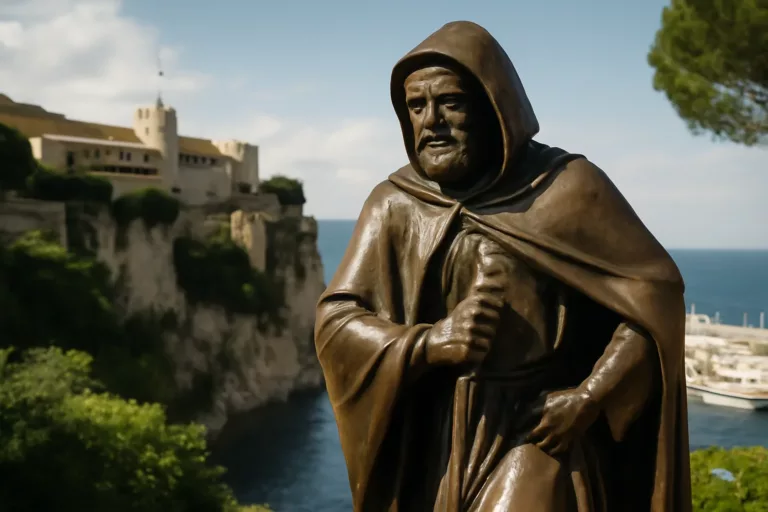
Today, the memory of François Grimaldi 1297 is woven into Monaco’s public symbols. The most visible is the statue of Malizia near the Prince’s Palace, showing a hooded figure holding a sword, evoking the legendary monk disguise and the sudden attack.
The coat of arms of the House of Grimaldi features two armoured monks as supporters, a direct reference to the traditional story of the assault. This heraldic choice underlines how the family embraces the legend as part of its identity.
At the same time, historians and educators in Monaco increasingly highlight the difference between romantic legend and documented fact. Rather than weakening the story of François Grimaldi 1297, this distinction makes it richer: the coup becomes both a historical event and a carefully shaped founding myth.
Conclusion: legend, fact and enduring meaning
The episode of François Grimaldi 1297 sits at the crossroads of history and storytelling. We can be confident that a daring surprise attack captured the Rock of Monaco and that François played a leading role. We can also recognise that later generations added detail, colour and symbolism to turn a brief coup into a founding legend.
For Monaco, this moment does more than explain how a fortress changed hands. It offers a narrative of resilience, cunning and survival for a small state in a competitive region. Understanding both the facts and the myths allows us to appreciate how a single night in 1297 helped shape centuries of identity on the Rock.
FAQ about François Grimaldi and the 1297 coup
Was François Grimaldi really disguised as a monk?
The famous monk disguise is central to the legend, but direct contemporary evidence is limited. Historians accept a surprise attack, while treating the specific costume as probable but not certain.
Did François Grimaldi become the first Prince of Monaco?
No. François seized the fortress and briefly controlled Monaco, but the formal title of Prince and stable dynastic rule developed later under his successors.
Why is François called Malizia?
The nickname Malizia suggests cunning or malice, reflecting his reputation for shrewd, sometimes ruthless tactics. It fits well with the story of the deceptive assault on the Rock.
How important was the 1297 coup for Monaco’s history?
The coup provided the symbolic starting point for Grimaldi rule. Even though control remained contested, later rulers used 1297 as a foundational date for their dynasty.
Is the statue of François Grimaldi historically accurate?
The statue near the Prince’s Palace is symbolic rather than strictly accurate. It represents the legendary monk-assailant and the spirit of the 1297 coup, not a documented likeness.
In practice, François Grimaldi 1297 should remain the guiding theme without replacing analysis of the real need and context.