
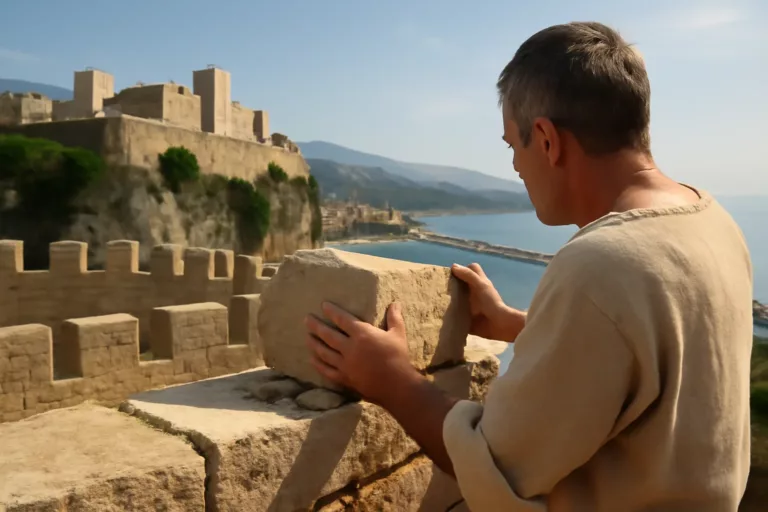
When people picture Monaco today, they rarely think back to Monaco fortress 1215, when the Rock was a raw, windswept promontory and not yet the setting of the Prince’s Palace. In that year, Genoese settlers began building a fortress that would change the destiny of the cliff and the tiny territory around it. Understanding why Monaco fortress 1215 was established helps explain how a military outpost became the core of a princely residence.
The Rock of Monaco before 1215
Before the Genoese arrived, the Rock of Monaco had already attracted attention. Ancient sailors used it as a landmark, and earlier fortifications had appeared and disappeared with shifting powers. Yet, by the early thirteenth century, the site was not a fully developed stronghold and certainly not the fortified complex that would later be known as Monaco fortress 1215.
To Genoa, a powerful maritime republic, the Rock offered something rare in the western Mediterranean: a natural stone bastion rising almost vertically from the sea, with a narrow access route that could be easily defended. It was the perfect canvas on which to build a new fortress and to anchor what historians now refer to as Monaco fortress 1215.
Why Genoa chose the Rock: geography and strategy
The Genoese decision to build in 1215 was not romantic; it was intensely practical. Several concrete advantages made the Rock irresistible and justified the creation of Monaco fortress 1215 as a long-term project.
- Natural defence: Sheer cliffs on three sides meant attackers could only approach by a narrow land route.
- Harbour control: The small bay below provided shelter for ships and a place to monitor maritime traffic.
- Coastal corridor: The Rock overlooked routes linking Provence and Liguria, vital for trade and military movement.
- Signal point: From the fortress, Genoa could relay messages along the coast using fires, flags or beacons.
In this sense, Monaco fortress 1215 was both a military installation and an information hub, knitting Genoa more tightly to its western frontier and allowing the city-state to coordinate fleets, convoys and diplomatic missions along the coast.
Genoese defensive objectives in 1215
The Genoese were not acting in a vacuum. The early 1200s were marked by rivalries with other powers, from neighbouring cities to feudal lords inland. Monaco fortress 1215 answered several pressing defensive needs and became one of the key outworks of Genoese power in the region.
Protecting trade routes and convoys
Genoa’s wealth flowed along sea lanes. Ships carrying grain, timber and luxury goods sailed close to the coast. A hostile outpost on the Rock could threaten those convoys. By occupying it and turning it into Monaco fortress 1215, Genoa transformed a potential danger into a shield that guarded both commercial and diplomatic traffic.
Galleys anchored below the fortress could shelter under its guns (or, at that time, its archers and stone-throwing engines). In a crisis, ships could take refuge while the garrison on the heights provided cover, demonstrating how effectively Monaco fortress 1215 integrated naval and land-based defence.
Deterring rivals and pirates
The fortress also sent a clear message to rivals and pirates: this stretch of coast was watched. A permanent garrison, storehouses and defensive walls made sudden raids more costly and less likely to succeed.
Even in an age before cannon, the combination of height, walls and disciplined soldiers gave the Genoese a strong deterrent. Any would-be attacker had to weigh the risk of being trapped between the cliffs and the sea under the eyes of the defenders positioned in Monaco fortress 1215.
Securing political influence inland
Control of the Rock was not only about the sea. From the fortress, Genoa could project influence into the valleys and hills behind the coast. Local lords knew that a powerful city-state now had a permanent foothold overlooking their lands.
This presence helped Genoa negotiate alliances, collect dues and intervene when conflicts threatened its interests. The very existence of Monaco fortress 1215 reinforced Genoa’s reputation as a power capable of holding and supplying distant strongpoints.
The first stone: what building a fortress meant in 1215
The act of laying the first stone in 1215 was both practical and symbolic. It marked the formal beginning of construction and the assertion of Genoese authority on the Rock.
| Aspect | What it meant in 1215 |
|---|---|
| Engineering | Cutting terraces into rock, raising walls and towers, and creating cisterns for water storage. |
| Logistics | Bringing stone, timber, food and tools by sea, then hauling them up steep paths. |
| Military | Installing a garrison, watch posts and defensive machines like mangonels or ballistae. |
| Symbolism | Publicly declaring Genoa’s claim, often with a ceremony involving local notables. |
Once the first stone of Monaco fortress 1215 was set, successive phases of construction would thicken walls, add towers and adapt the layout to new threats and technologies, ensuring that the stronghold remained relevant as warfare evolved.
From Genoese fortress to the future Prince’s Palace
Although the builders of 1215 could not foresee it, the stronghold they established would become the nucleus of the future Prince’s Palace. Several early choices helped make that transformation possible.
A site designed for permanence
The Genoese did not build a temporary camp. They carved foundations into solid rock and designed structures to last. Over time, these foundations could be reused, extended and refined rather than demolished.
As political control of Monaco shifted in later centuries, new rulers could adapt existing halls and towers of Monaco fortress 1215 instead of starting from scratch, turning defensive spaces into ceremonial rooms and residential apartments.
Administrative as well as military spaces
Even in its early form, the fortress needed rooms for records, negotiations and storage of taxes in kind. These quasi-administrative spaces were the seeds of later state rooms and reception halls.
When Monaco’s rulers eventually turned the stronghold into a residence, they built on this mixed heritage: part fortress, part centre of power. The practical layout of Monaco fortress 1215, with its blend of barracks, storerooms and meeting areas, made later adaptation far smoother.
Shaping the identity of the Rock
By occupying and fortifying the Rock in 1215, Genoa fixed its identity as a place of command. Later architectural refinements, Renaissance façades and ceremonial courtyards all rested on that original decision to treat the cliff as a seat of authority.
The future palace would preserve traces of its military past in its thick walls, elevated position and the way it dominates the harbour below, constant reminders that the glamorous residence grew from the stern outlines of Monaco fortress 1215.
Conclusion: a small fortress with a long legacy
The Genoese construction of the fortress on the Rock in 1215 was a targeted response to strategic needs: protect trade, deter enemies and anchor influence on a crucial stretch of coast. Yet the decision had consequences far beyond the concerns of that decade.
By choosing this site, investing in durable stonework and blending military and administrative functions, the builders unwittingly prepared the ground for the future Prince’s Palace. Today’s ceremonial residence still echoes the original stronghold, reminding visitors that Monaco’s story began not with glamour, but with a vigilant outpost known to historians as Monaco fortress 1215, watching the sea and shaping the fate of a small but pivotal rock.
FAQ about the early fortress on the Rock
Why did the Genoese build a fortress on the Rock in 1215?
They wanted to secure a natural strongpoint that could protect their trade routes, control a strategic harbour and project power along the Ligurian and Provençal coasts.
How did the fortress protect Genoese trade?
The garrison watched passing ships, sheltered convoys in the bay below and provided armed support against pirates or rival fleets operating near the coast.
Was the original fortress already a residence?
It was primarily military, with basic living quarters and storage. Over time, administrative and residential functions expanded, paving the way for a princely residence.
What made the Rock of Monaco so defensible?
Steep cliffs on most sides, a narrow land access, and a commanding view of sea routes made it hard to attack and ideal for surveillance.
How is the medieval fortress linked to the modern Prince’s Palace?
The palace grew out of the original stronghold’s walls, towers and foundations, transforming a defensive citadel into the ceremonial heart of Monaco.