The history of Monaco sovereignty is not a tale of chance. It emerged from calculated alliances, selective concessions and timely legal recognitions that allowed a tiny principality to keep its autonomy while larger neighbours were absorbed or reshaped. Understanding this trajectory means looking at how law, symbolism and diplomacy worked together over centuries.
This overview focuses on five main keys that help explain how Monaco preserved its sovereignty, from the rise of the Grimaldi family to its contemporary status as a recognised European microstate. Rather than listing every event, it highlights the mechanisms that repeatedly helped the principality survive in a region marked by shifting borders and competing empires.
1. Dynastic Control and the Early Grimaldi Strategy
Monaco’s survival began with the Grimaldi family’s ability to turn a vulnerable coastal fortress into a stable princely seat. From the late 13th century, they recognised that they could not outfight regional powers, so they focused on legitimacy, continuity and recognisable authority instead of sheer military strength.
Several aspects of this early strategy stand out:
- Hereditary rule: A clear ruling line made it easier for neighbouring powers to recognise a single authority, sign treaties and maintain predictable relations. Even when overlords changed, the Grimaldi remained the reference point on the Rock.
- Marital alliances: Strategic marriages linked Monaco to influential families in Italy and France. These ties offered informal protection and channels of influence without formal annexation.
- Symbolic control of the Rock: Holding the fortress on the Rock of Monaco acted as a visible sign that the Grimaldi were the legitimate rulers. The stronghold became more than a military point; it symbolised a continuous political entity across changing regional frameworks.
By presenting themselves as reliable, long-term rulers, the Grimaldi encouraged greater powers to treat Monaco as a distinct political unit rather than a disposable possession. This perception laid the foundation on which later claims to sovereignty could rest.
2. Balancing Between France and Spain
A second key in the history of Monaco sovereignty was the principality’s ability to navigate between France and Spain. From the 15th to the 17th century, these two kingdoms competed for control of Mediterranean routes and coastal strongholds. Monaco used this rivalry to secure protection while defending its internal autonomy.
In practice, this balancing act involved several recurring patterns:
- Shifting protectorates: The princes accepted the protection of one power, then the other, when circumstances changed. They did so without surrendering their dynastic identity or abandoning the claim that Monaco remained a principality in its own right.
- Preserving internal control: Even under protection treaties, Monaco maintained its own laws, taxation and justice. External allies took responsibility for wider security, but the core of domestic authority remained firmly in princely hands.
- Offering strategic value: As a fortified harbour and observation point on a key stretch of coast, Monaco was more useful to great powers as an allied outpost than as a fully integrated province. Annexation risked provoking rivals, whereas a loyal, semi-autonomous principality could serve shared interests.
This pattern created a durable model: Monaco could acknowledge external influence in defence and foreign affairs while insisting on local control over everyday governance. The principality survived not by isolation, but by making itself a small yet valuable partner in the power politics of Western Europe.
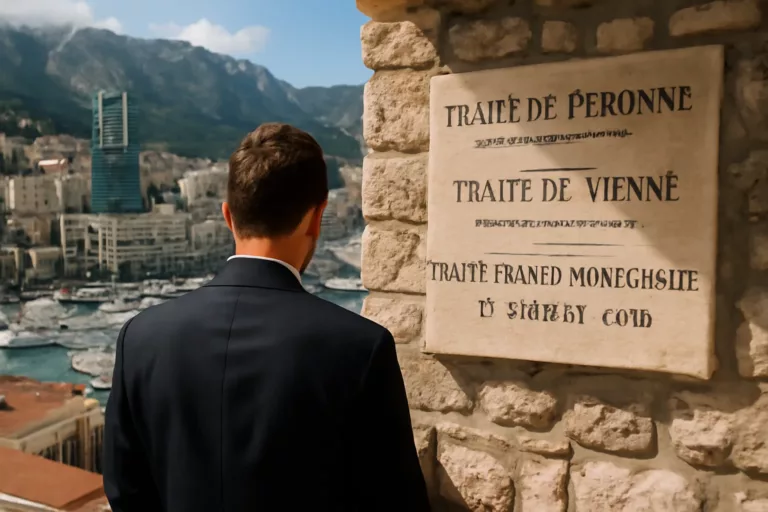
3. The 1641 Treaty of Péronne: A Legal Turning Point
One of the clearest milestones in the history of Monaco sovereignty is the Treaty of Péronne (1641). Prince Honoré II used this agreement to shift decisively into the French sphere while securing explicit recognition of his authority.
The treaty can be summarised through three main effects:
- Firm French alignment: Monaco left the orbit of Spain and accepted France as its protector. This gave the principality a powerful sponsor in a turbulent region and reduced the likelihood of being traded or occupied in wider conflicts.
- Recognised princely authority: The document confirmed the prince’s control over internal governance instead of treating Monaco as ordinary French territory. It acknowledged that the principality retained its own institutions under the Grimaldi.
- Defined military obligations: Monaco’s strategic role and duties towards France were clarified, including the status of its fortress and harbour. This reduced the risk of arbitrary demands or reinterpretations of its obligations.
The Treaty of Péronne did not create full independence in the modern sense, but it fixed Monaco’s status as a principality under protection rather than a province. That legal nuance later became a crucial argument when the Grimaldi defended their position during subsequent European realignments.
4. Navigating the 19th Century: Losses, Gains and Recognition
The 19th century was dangerous for small states. New nation-states emerged, borders were redrawn and many minor rulers disappeared in the wake of revolutions and unification movements. Monaco survived by combining limited concessions with targeted recognitions.
Key developments included:
- Territorial losses: The principality eventually gave up Menton and Roquebrune after prolonged tensions and local unrest. This reduced its territory but removed zones of chronic instability that could have invited external intervention.
- The 1861 Franco-Monegasque Treaty: France formally recognised Monaco’s sovereignty while confirming its own influence over certain external matters. In exchange for territorial adjustments and financial arrangements, the principality obtained a clear international acknowledgment of its status.
- Economic repositioning: Monaco began to focus on tourism and gaming, developing an economic profile that distinguished it from surrounding regions. As its military importance declined, its economic usefulness increased, lowering the incentive for annexation.
By accepting a smaller territory and a limited diplomatic role, Monaco obtained what mattered most: survival as a sovereign state. The episode illustrates how, for a microstate, controlled retreat in some areas can secure long-term independence and reduce the triggers for direct takeover.
5. 20th Century Treaties and Modern Microstate Diplomacy
In the 20th century, the main challenge was to translate historical arrangements into fully recognised modern sovereignty. Monaco relied on treaties with France, constitutional reforms and active diplomacy to consolidate its position in a world shaped by international law and multilateral institutions.
From Protectorate to Partner
Revised agreements with France gradually rebalanced the relationship. While France retained responsibilities in defence and certain external affairs, Monaco gained more room to manage internal policy and to sign some international agreements in its own name. The tone shifted from protectorate-style dependence towards a more clearly defined partnership between two states with linked interests.
Constitutional Modernisation
Constitutional reforms introduced representative institutions and defined the powers of the prince in legal terms. This modern framework improved Monaco’s image abroad, aligning it with contemporary expectations of governance while preserving the central role of the Grimaldi dynasty. Written rules about succession, parliamentary life and civil rights helped show that Monaco was adapting to new political standards rather than relying solely on historical privilege.
Active International Presence
By joining international organisations and concluding bilateral agreements, Monaco ensured that its sovereignty was visible and regularly acknowledged. Participating in global debates on finance, the environment and culture signalled that the principality functioned as an engaged state, not just a relic of earlier dynastic systems. Its long record of negotiated autonomy, combined with a stable political system, gave it credibility among other states.
This active presence turned historical claims into current, practical realities. Each treaty signed in Monaco’s name and each seat taken in an international forum reinforced the idea that the principality was a continuing subject of international law.
Practical Lessons from Monaco’s Experience
Looking at the history of Monaco sovereignty, several broader lessons emerge for understanding how very small states can endure:
- Clear dynastic or institutional continuity helps outsiders know whom to recognise and negotiate with.
- Legal texts, even when they confirm dependence in some areas, can protect a core of autonomy if they carefully specify rights and obligations.
- Strategic concessions, such as territorial losses or shared foreign policy, may preserve statehood better than uncompromising resistance.
- Economic distinctiveness can make a microstate useful to its neighbours in ways that do not require annexation.
- Active, visible participation in international life turns historical claims into current, enforceable realities.
Monaco’s path shows that sovereignty for a microstate is rarely absolute and never static. Through dynastic strategy, skilful management of great-power rivalries, pivotal treaties, 19th century compromises and modern diplomacy, the principality turned structural vulnerability into a durable advantage. Its experience illustrates how law, symbolism and negotiation can allow a very small territory to maintain a recognised place on the European map over many centuries.
FAQ about Monaco’s Sovereignty
Why did larger powers tolerate Monaco’s independence?
Monaco was more useful as a friendly outpost than as a contested province. Its small size, strategic location and willingness to align with a major ally reduced the incentive to absorb it directly and risk conflict with rivals.
Did Monaco ever face serious risk of annexation?
Yes. During periods of territorial reorganisation and national unification, annexation was a real possibility. Monaco reduced this risk by accepting protection treaties, giving up contested areas and emphasising its legal status as a principality rather than a mere locality.
How important was the Grimaldi family to Monaco’s survival?
The Grimaldi dynasty was central. Its continuity provided a recognised authority, enabled long-term alliances and gave Monaco a consistent diplomatic voice across changing European systems, reinforcing the perception of a stable state.
Is Monaco fully independent today?
Monaco is a sovereign state but maintains close treaty-based ties with France, particularly in defence and some external affairs. These arrangements are longstanding and reflect mutual interests rather than simple dependence.
What makes Monaco different from other European microstates?
Monaco combines an old ruling dynasty, a dense history of protection treaties and a strong economic profile centred on services and tourism. This mix has given it a distinctive way of sustaining sovereignty over time while remaining closely linked to its larger neighbour.