
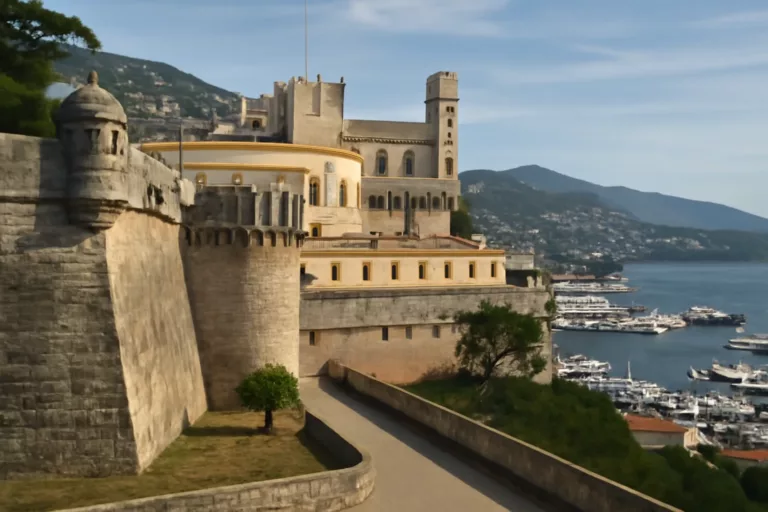
The history of the Prince’s Palace Monaco is written in stone. Over five centuries, a stark Genoese fortress on a rocky promontory slowly evolved into a refined sovereign residence, mirroring the political rise of the Grimaldi family and the changing tastes of Europe. Understanding the history of the Prince’s Palace Monaco also means reading how each period left its mark on walls, courtyards and interiors.
From Genoese Stronghold to Grimaldi Stronghold (13th–16th centuries)
The story begins in 1215, when the Republic of Genoa built a fortress on the Rock of Monaco to control maritime routes. Its first incarnation was purely military: thick curtain walls, narrow arrow slits, a central keep and minimal comfort. The site was chosen for defence, not beauty, a key starting point in the long history of the Prince’s Palace Monaco as a strategic outpost.
In 1297, François Grimaldi seized the fortress by surprise. Under the early Grimaldi lords, the complex remained mainly a garrison. Key architectural features of this period included:
- Massive defensive walls hugging the cliff edge
- Square towers designed for surveillance and archers
- Inner courtyards used for storage and troop movement
- Small, dark rooms prioritising safety over comfort
While some domestic spaces appeared, the overall character stayed austere. The building’s main purpose was to protect a vulnerable territory in a turbulent Mediterranean world, and the early history of the Prince’s Palace Monaco reflects this defensive mindset.
Renaissance Aspirations: A Palace Takes Shape (16th century)
As the Grimaldis gained status, the medieval fortress slowly acquired the language of a princely residence. Renaissance ideas, travelling along Italian trade routes, began to soften the stark military lines and altered the history of the Prince’s Palace Monaco from simple stronghold to emerging court.
Key transformations included the creation of an arcaded courtyard, more regular façades and decorative stonework. The rulers wanted visitors to perceive Monaco not just as a stronghold, but as a small, cultured court.
Architecturally, this meant:
- Adding loggias and arcades to create gracious circulation
- Enlarging windows to bring light into formerly dark halls
- Introducing classical proportions to façades and doorways
- Decorating interiors with painted ceilings and carved details
The history of the Prince’s Palace Monaco at this stage is one of balance: defensive structures remained vital, yet the building started to express prestige and taste, blending security with aesthetic ambition.
Baroque Flourish and Formal Apartments (17th–18th centuries)
The 17th and 18th centuries marked a decisive shift from fortress to ceremonial palace. Influenced by French and Italian Baroque, the Grimaldis reimagined the residence as the heart of a sovereign court, and the history of the Prince’s Palace Monaco entered a phase of theatrical display and protocol.
Several architectural moves defined this era:
The palace’s interior layout changed to suit courtly life. Enfilades allowed processions, while grand staircases and galleries showcased dynastic art. The building now communicated stability, legitimacy and cultural refinement, consolidating the history of the Prince’s Palace Monaco as the seat of a recognised dynasty.
Revolution, Damage and 19th-Century Revival
Political upheaval in the late 18th century disrupted this evolution. During revolutionary and Napoleonic periods, the palace suffered neglect and partial damage. Furnishings were dispersed, and some spaces lost their ceremonial role.
The 19th century brought a deliberate revival. Successive princes launched restoration campaigns to recover the dignity of the residence. Their approach combined historical respect with contemporary comfort:
- Recreating lost decorative schemes using surviving records
- Reorganising service areas to separate staff circulation from formal rooms
- Improving natural light and ventilation without sacrificing historical character
- Introducing modern amenities discreetly into thick medieval walls
This period is crucial in the history of the Prince’s Palace Monaco because it fixed the image many visitors recognise today: a palace that appears timeless, yet is the result of careful 19th-century choices and curated restorations.
Modernisation, Preservation and Living Heritage (20th–21st centuries)
In the 20th century, the palace had to adapt to new expectations of comfort, security and public access. The challenge was to modernise a historic building without erasing its layered past, ensuring the history of the Prince’s Palace Monaco remained legible in every wing and courtyard.
Architects and conservators worked together to:
- Strengthen structures while respecting original masonry
- Install modern systems (electricity, climate control) invisibly
- Protect fragile artworks and finishes from growing visitor numbers
- Maintain ceremonial functions alongside everyday residence needs
Recent restoration campaigns focus on conservation rather than transformation. Each intervention is documented, reversible where possible and guided by research into earlier states of the building.
Today, the palace functions as both home of the princely family and symbol of Monaco’s continuity. Visitors experience a sequence of spaces that quietly reveal the journey from coastal fortress to sovereign residence, and the ongoing history of the Prince’s Palace Monaco as a living monument.
Conclusion: Reading Five Centuries in Stone
Seen as a whole, the history of the Prince’s Palace Monaco is a lesson in architectural adaptation. Military necessity, Renaissance ambition, Baroque ceremony, 19th-century restoration and modern conservation have all left visible traces that can still be read on façades and interiors.
For anyone interested in architecture or heritage, the palace offers a compact, tangible timeline of European taste and political change, compressed onto a single rocky outcrop above the Mediterranean and preserved as an evolving residence rather than a frozen museum.
FAQ about the Palace’s Architectural Evolution
How old is the Prince’s Palace in Monaco?
The site dates back to a Genoese fortress founded in 1215, with continuous transformations over more than 800 years of occupation by the Grimaldi family.
When did the fortress start to become a palace?
The shift began in the 16th century, when Renaissance ideas inspired larger windows, arcades and more comfortable living spaces within the former stronghold.
What is the most visible Baroque feature today?
The sequence of state apartments, with their decorated ceilings and formal layout, best illustrates the Baroque phase of the palace’s transformation.
Was the palace badly damaged during the French Revolution?
It suffered neglect, loss of furnishings and some structural impact, but later 19th-century restoration campaigns repaired and reinterpreted much of the damage.
Is the palace still changing architecturally?
Yes. Current work focuses on conservation, discreet modern upgrades and careful restoration, ensuring the building remains a living residence as well as a historic monument.