
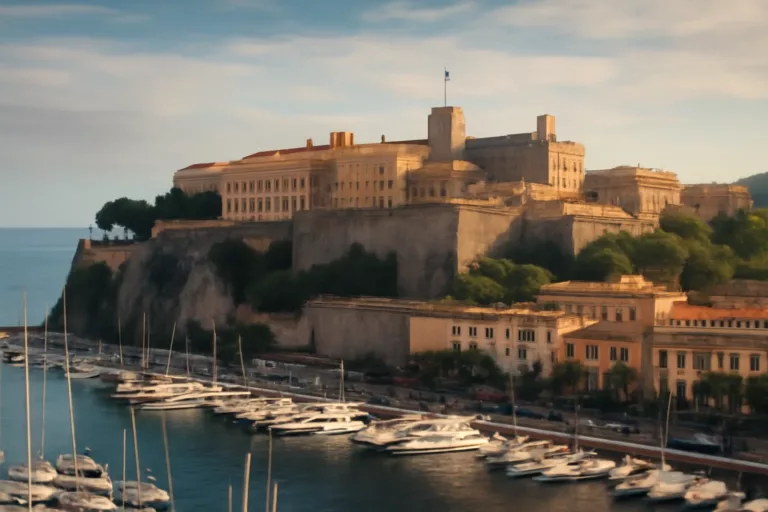
The years of the French Revolution and the Napoleonic wars were short but transformative for Monaco. Between 1789 and the fall of Napoleon, the small principality on the Rock was annexed, renamed and, for a time, erased as a sovereign state. Yet the same period forced Monaco and the Grimaldi dynasty to rethink how they ruled and how they presented themselves to the outside world.
From the Rock, the upheavals in Paris were never just a distant drama. New laws, symbols and officials arrived directly in the town. Long-standing habits of princely authority met the language of citizenship, equality and republican virtue. Out of this clash came a series of shifts that reshaped institutions, public life and everyday experience.
This episode in Monaco’s history can be followed through several key changes: annexation and the new name of Fort-d’Hercule, the fall of dynastic authority, the arrival of French administration, pressure on the Prince’s Palace, economic and social disruption and, finally, the difficult road back to principality.
1. From protectorate to annexation: Monaco becomes Fort-d’Hercule
Before 1789, Monaco was a sovereign principality. It relied on France for protection and was bound to the French crown by treaties, but it remained formally independent and the Grimaldi exercised their own authority on the Rock. The Revolution in France broke this balance.
Revolutionary leaders saw small courts associated with the ancien régime as awkward survivals rather than useful allies. In 1793, the National Convention voted to annex Monaco. On paper, the principality disappeared and its territory was incorporated into revolutionary France. The Rock was renamed Fort-d’Hercule, an old name revived in a very different context, now detached from the dynastic identity of Monaco.
Annexation altered Monaco’s position in several ways:
- The Prince lost sovereignty and his own independent institutions.
- Monaco’s borders became part of the French national frontier.
- The Rock acquired a reinforced role as a coastal strongpoint in wartime.
For the Grimaldi, this was far more than a diplomatic shift. It questioned the assumption that their rule was natural and enduring, and showed that a larger republic could absorb and rename the territory according to its own political priorities.
2. The fall of the Grimaldi dynasty’s authority
Once annexation was confirmed, the Grimaldi were treated like other former ruling families brought under French control. Noble privileges were abolished. Feudal dues and seigneurial rights that had long supported the princely household disappeared. The Prince and his relatives lost formal power and could even be viewed as politically suspect.
Property connected with the family risked being declared national if its owners were classed as émigrés or enemies of the Revolution. Influence at court or in local bodies no longer provided protection. Decisions affecting the Rock were taken by representatives of the Republic, not by the dynasty whose name had long been attached to the territory.
The symbolic change was just as important. Public life no longer revolved around the person of the Prince. Civic festivals, republican ceremonies and tricolour flags replaced spectacles that had once celebrated the ruling house. For a dynasty that had built its legitimacy on continuity, this was a deep shock and a warning that hereditary authority could be suspended or removed.
3. New French administration on the Rock
One of the clearest effects of this period was the arrival of a new administrative framework. The annexed territory was integrated into a French department and subjected to the same legislation as communities far from the Mediterranean coast.
Local governance changed in several areas:
- Municipal structures: a commune system with a mayor and councillors replaced princely councils.
- Uniform law: revolutionary measures on property, civil status and justice applied to inhabitants, narrowing the scope for older local customs.
- Civic culture: oaths to the Republic, public festivals and symbols such as liberty trees promoted the idea of citizens rather than subjects.
For residents, this modernisation was mixed in its impact. Some welcomed clearer rules, the end of certain dues and the promise of more equal treatment before the law. Others resented the loss of familiar procedures and felt that decisions were now taken far away, according to principles shaped in Paris rather than on the Rock.
4. The Palace under pressure: from princely residence to republican space
The Prince’s Palace, dominating the Rock, stood at the centre of these changes. Built and expanded as the visible expression of dynastic power, it suddenly sat uneasily in a political order that mistrusted hereditary rule.
During annexation, the Palace came under several forms of pressure:
- Confiscation and reuse: like other noble residences, parts of the complex could be requisitioned for administrative or military purposes in the service of the Republic.
- Loss of ceremonial life: court receptions, dynastic celebrations and formal audiences stopped, ending the rhythms of court society that had structured elite life.
- Risk of neglect: without its role as an active seat of power, the building was vulnerable to physical deterioration and functional alteration.
When the Grimaldi later returned, restoring the Palace involved more than structural repair. They needed to re-establish it as a living emblem of political authority after years during which it had been treated as a practical asset rather than a sovereign residence. The history of the building in these decades thus echoes the wider tension between monarchical and republican visions.
5. Economic and social shocks on the Rock
Revolution, annexation and almost continuous war also reshaped daily life. Monaco’s modest economy depended on regional trade, maritime activity and spending by the court and visiting elites. Each of these pillars was affected.
Several patterns emerged:
- Military priorities came to the fore as the coastline acquired strategic importance in Mediterranean operations.
- New taxation replaced older dues with republican contributions that were often perceived as more rigid and harder to negotiate.
- Population movements brought administrators, soldiers and sometimes refugees to the Rock, while some established families left or saw their fortunes wane.
Social relations adjusted to the new atmosphere. Revolutionary ideas about equality and citizenship provided language and occasions for questioning traditional deference. Local elites who had derived their status from proximity to the Prince were obliged to redefine their position under a regime that valued civic merit and loyalty to the Republic more than lineage.
6. Aftermath and the road back to principality
The annexation years ended only after the collapse of Napoleon’s rule. Diplomatic settlements, including the Congress of Vienna, allowed Monaco to reappear as a principality. This time it stood under the protection of the Kingdom of Sardinia rather than revolutionary France. Sovereignty returned, though within a framework of international guarantees and external oversight.
The experience of annexation left a lasting mark. It showed that small states could not rely solely on inherited status; they needed clearly defined protections in the European system. It also underlined that dynasties had to adapt their image, presenting themselves as guardians of stability and measured reform rather than of outdated privilege. Finally, administrative and legal innovations introduced under French rule proved difficult to remove entirely and influenced later developments.
In this sense, the revolutionary period did not simply interrupt Monaco’s history; it redirected it. Subsequent changes in the principality’s politics, economy and external alliances were shaped by memories of how quickly independence had once been lost and under what conditions it had been recovered.
Conclusion: a small state in a great revolution
Monaco’s experience during the French Revolution illustrates how even a very small state can be drawn fully into a wider upheaval. Annexation as Fort-d’Hercule, the eclipse of the Grimaldi dynasty, the arrival of French administration, pressure on the Palace and deep economic and social disruption together marked a turning point for the Rock.
When the principality re-emerged, it did so with a sharper awareness of both its vulnerability and its strategic value. The lessons of those years still inform the way Monaco balances its independence with the realities of existing beside a much larger neighbour.
FAQ
Was Monaco independent during the French Revolution?
No. In 1793, Monaco was annexed by revolutionary France and became the commune of Fort-d’Hercule. Its status as a sovereign principality was suspended until after the Napoleonic period.
How did annexation affect the Grimaldi dynasty?
The dynasty lost political authority, privileges and key sources of revenue. Its property was exposed to confiscation when owners were suspected of hostility to the Revolution, and its role in public life was replaced by republican institutions and symbols.
What administrative changes did Monaco experience?
Monaco was integrated into a French department, governed as a commune with a mayor and councillors, and subjected to revolutionary laws on property, justice and civil status instead of older princely customs.
What role did the Prince’s Palace play during this period?
The Prince’s Palace lost its function as a princely residence and ceremonial centre. It could be reused for administrative or military purposes and risked neglect, symbolising the suspension of dynastic authority during annexation.
Did this period have lasting effects on Monaco?
Yes. It reshaped Monaco’s political status, pushed the Grimaldi to modernise their rule and left administrative and legal models that influenced the principality after independence was restored.