In 1863, Monaco did not simply evolve into a new phase; it consciously broke with its fragile rural past and embraced tourism, leisure and spectacle as the core of its future. That year, a casino concession and the creation of Monte-Carlo set the principality on a new course that still shapes its streets, economy and international reputation.
Understanding what happened in 1863 helps explain how a tiny territory became associated with luxury and entertainment rather than remaining a quiet coastal enclave on the Mediterranean.
Monaco Before 1863: A Principality Under Pressure
In the early nineteenth century, Monaco relied mainly on agriculture, small trades and modest customs revenues. These limited resources could not sustain ambitious public works or protect the state from economic shocks.
The principality’s position weakened further when neighbouring towns detached themselves from Monaco, taking with them land, population and tax income. The Grimaldi rulers were left with a narrow strip of coastline and a reduced economic base. At a time when large nation-states and industrial powers were reshaping Europe, Monaco risked sliding into political and financial irrelevance.
By the early 1860s, traditional solutions had reached their limits. The authorities could not compensate for lost territory through agriculture or industry alone. A different strategy was needed, one that would treat Monaco’s small size and lack of heavy industry as potential strengths rather than insurmountable weaknesses.
Why 1863 Became a Turning Point
The crucial insight of 1863 was that Monaco could not compete through production, but it could compete through experience. Its mild climate, dramatic coastline and political autonomy made it well suited to becoming a resort aimed at international visitors.
The leadership chose to build an economic model centred on attracting wealthy travellers rather than depending on a modest local tax base. Three linked decisions defined this shift:
- Granting a concession to operate a modern casino capable of generating regular income.
- Designing a new district, Monte-Carlo, specifically to host, entertain and impress visitors.
- Encouraging the development of hotels, gardens and entertainment venues around this new core.
These measures did more than diversify revenue. They redefined the role of the state, placing hospitality, urban planning and the management of public image at the centre of policy-making.
The Casino: Engine of a New Economic Model
The casino concession became the financial pivot of the transformation. Instead of relying primarily on taxes from a small resident population, the state could tap into the spending of visitors who came to gamble, socialise and enjoy the climate.
The impact of the casino soon extended beyond its gaming rooms:
- Employment: Croupiers, attendants, clerks and maintenance staff found work directly in the casino, while ancillary jobs appeared in hotels, transport and local services.
- Investment: Foreign capital financed new buildings and modern amenities, from improved lighting to more reliable water supply.
- Infrastructure: Roads, public services and urban improvements were developed to support the steady flow of guests.
Public finances were transformed. Gaming receipts and related tourism spending allowed the state to upgrade streets, lighting and public spaces. These improvements made Monaco more attractive, creating a reinforcing cycle: better infrastructure drew more visitors, and their expenditure funded further enhancements.
Monte-Carlo: A District Built for Visitors
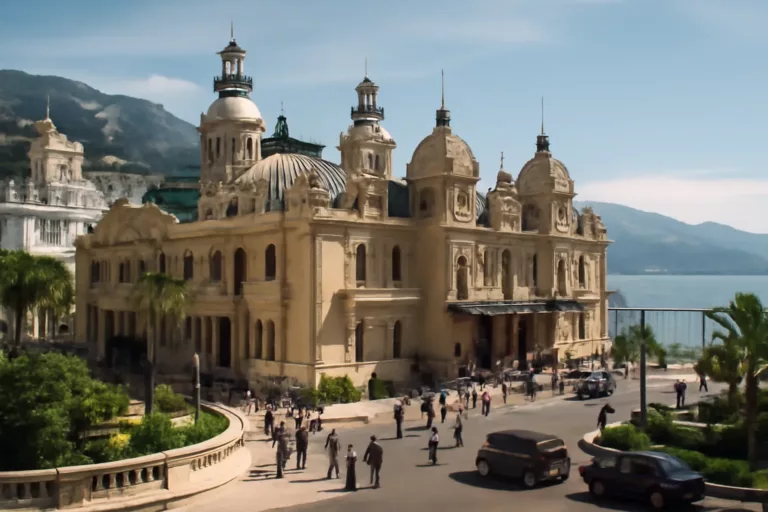
The creation of Monte-Carlo gave a physical form to this new economic vision. Planned on a promontory overlooking the sea, the district was designed to impress at first sight, combining architecture, gardens and views into a coherent setting for leisure.
Monte-Carlo brought several functions together in one compact area:
- The casino, serving both as economic motor and architectural landmark.
- Grand hotels providing comfort, privacy and prestige for an international clientele.
- Landscaped gardens and promenades that encouraged strolling, conversation and display.
- Halls and venues dedicated to music, performances and social events.
This concentration created a kind of stage on which visitors could experience a carefully composed version of Riviera life. The layout and atmosphere of Monte-Carlo were instruments for attracting and retaining guests who would spend money in the principality and carry its new image back home.
New Establishments and Changing Daily Life
The rise of Monte-Carlo quickly altered everyday life in Monaco. Around the casino and hotels, a dense network of establishments emerged: cafés with terraces, restaurants tailored to foreign tastes, shops selling clothing and luxury goods, and practical services such as laundries and carriage hire.
For residents, this shift brought both opportunities and adjustments:
- Diversified work: Jobs appeared in hospitality, transport, retail and personal services, supplementing or replacing traditional rural activities.
- New businesses: Local and foreign entrepreneurs opened small enterprises aimed at the growing visitor population.
- A seasonal rhythm: Life began to follow the tourist calendar, with busy winters and quieter months dedicated to maintenance and preparation.
The streets became more cosmopolitan as foreign languages, fashions and customs mingled with local traditions. The state had to develop regulations for gaming, public order and construction to protect both revenue and reputation in this rapidly changing environment.
Reinventing Monaco’s International Image
Before 1863, Monaco attracted limited attention beyond its immediate neighbours. The development of Monte-Carlo and the growing fame of the casino changed this dynamic. Travel writers and journalists started to include the principality in their accounts of the Riviera, and stories about the gaming rooms and sea views circulated widely.
Several features made Monaco stand out among coastal destinations:
- A mild winter climate that appealed to visitors from colder regions.
- Improved transport links that brought the Mediterranean coast within easier reach.
- The novelty of a sovereign microstate openly organised around leisure.
- The presence of aristocrats and wealthy industrialists, which helped to reinforce an aura of prestige.
Monaco effectively turned its small size into a distinctive identity. The principality became known less for its fields and workshops and more for its salons, terraces and carefully maintained gardens. The image forged in the 1860s still informs how the world perceives Monaco today.
From 1863 to Today: A Lasting Legacy
The choices made in 1863 continue to influence Monaco’s development. The economy has since diversified into finance, real estate and international events, yet services, tourism and high-end experiences remain central. Visitors still encounter a landscape organised around hospitality, entertainment and meticulously managed public spaces.
The broader lesson from this period is one of strategic adaptation. Confronted with limited land, a small population and the loss of traditional income, the principality chose to specialise in experiences rather than production. The combination of a casino concession, a purpose-built district and a supportive network of establishments proved flexible enough to endure political and economic shifts.
Understanding this turning point helps explain why such a small territory enjoys an outsized presence in global culture. The modern image of Monaco as a compact centre of leisure and prestige can be traced back to the decisions taken in 1863, when the principality adopted a new economic identity and recast its role on the Mediterranean stage.
FAQ
Why is 1863 viewed as the birth of modern Monaco?
In 1863 the principality adopted a new economic model based on tourism and leisure, centred on the Casino and the Monte-Carlo district, replacing a fragile rural system that no longer met its needs.
How did the Casino reshape Monaco’s finances?
The Casino generated steady income from international visitors, allowing the state to rely less on local taxation, invest in infrastructure and support urban improvements and public services associated with tourism.
What role did Monte-Carlo play in the transformation?
Monte-Carlo served as a purpose-built resort district that concentrated the Casino, luxury hotels, gardens and entertainment venues, projecting a unified image of refinement that attracted and retained visitors.
Did residents benefit from the new establishments?
Residents gained access to new jobs and business opportunities in hospitality, services and construction, but also had to adapt to a more seasonal economy and an increasingly cosmopolitan everyday life.
Is the economic model launched in 1863 still visible today?
Yes. Although Monaco has diversified into finance, real estate and international events, it still relies heavily on services, tourism and high-end experiences that grew out of the model established in 1863.